 War leaves its marks in many ways.
Some are visible. Others are carried quietly.
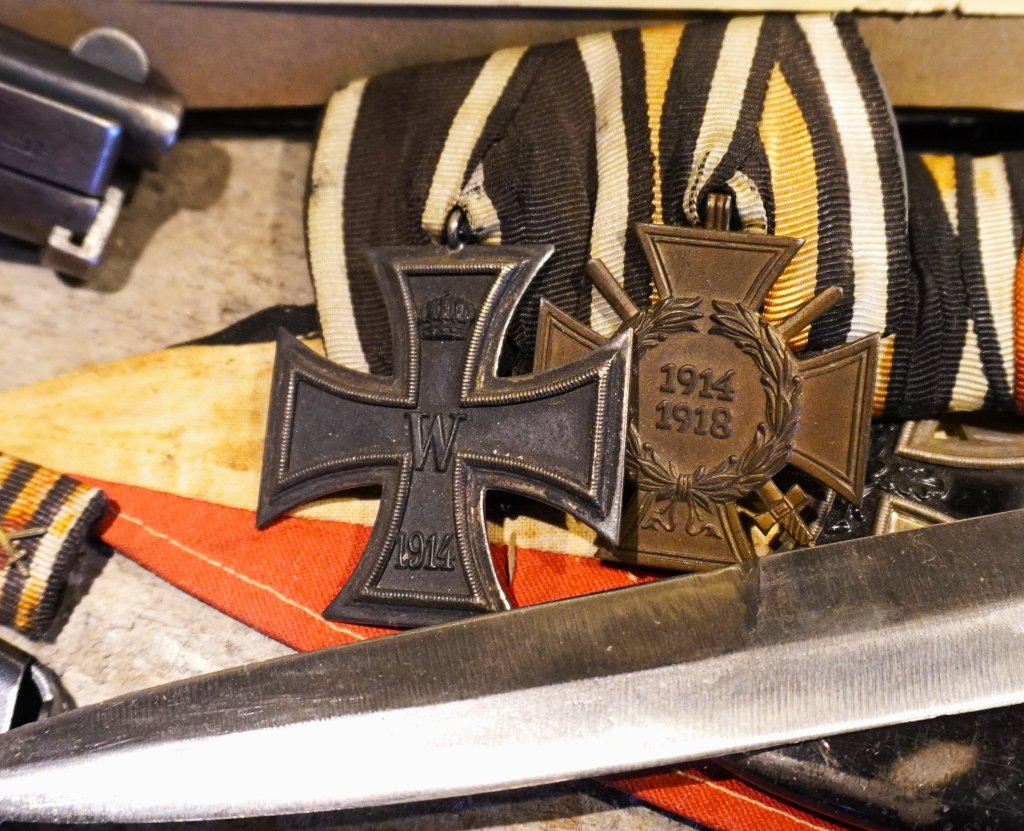
The medals displayed here represent how a nation chose to recognize those who endured the First World War. Among them is the Iron Cross, one of the most iconic German military decorations, awarded for bravery in combat. First established in the 19th century and revived during the war, it became a symbol of courage under fire—earned on battlefields where survival was never guaranteed.
Beside it is the Hindenburg Cross, issued after the war to those who had served. Unlike decorations awarded in the moment of combat, this medal came later—when the war had ended, when the uniforms were put away, and when the reality of what had been experienced began to settle in.
Together, these medals represent two different moments in a soldier’s life.
One, earned in the immediacy of battle—recognition for action taken under extreme conditions.
The other, given afterward—recognition simply for having been there.
They are small objects.
Metal, ribbon, stamped design.
But they carry weight far beyond their size.
Each one represents a moment, a decision, a survival. Behind every medal is an individual—someone who stood in the mud of the trenches, endured artillery, faced uncertainty, and continued forward when stopping was not an option.
They were worn with pride.
But also with memory.
For some, these medals were reminders of achievement. For others, they became quiet symbols of loss—of comrades who did not return, of battles that could not be forgotten, and of a war that changed everything it touched.
Look closely at them.
They are uniform in design, issued in large numbers, part of a system meant to recognize service across an entire army. And yet, each one is tied to a single life, a single experience that cannot be fully captured in metal.
Preserved within the collection of Ghosts of the Battlefield, these medals remind us that recognition is only part of the story.
What they represent—the moments they were earned in, and the lives that carried them afterward—remains far more complex.
War marked those who fought it.
These are the marks that remained.

 War leaves its marks in many ways.