From the Collection: Equipment of the Soldiers of the Rising Sun
The Pacific War was defined not only by battles, but by the environments in which those battles were fought. Endurance, Isolation, and the Limits of Survival
March 27, 2026

 The Pacific War was defined not only by battles, but by the environments in which those battles were fought. Jungle, heat, disease, isolation, and distance shaped the experience of every soldier who entered the fight. For the Imperial Japanese Army, warfare often meant operating far from supply, cut off from reinforcement, and dependent almost entirely on what could be carried on the body. This field kit represents that reality—a system of equipment built not for comfort, but for endurance.
At the center of this display is the Type 90 Japanese steel helmet, shown here with field-applied netting. Introduced in the early 1930s, the Type 90 was the standard combat helmet of the Imperial Japanese Army throughout World War II. Its shape and construction offered basic protection, but its true value in the Pacific often lay in concealment. The addition of netting was a common field modification, allowing soldiers to attach vegetation or break up the helmet's outline. In dense jungle terrain, where visibility was limited and ambush was a constant threat, blending into the environment was often as important as armor itself.
Beside it rests the Type 94 Japanese canteen, a simple but essential piece of equipment. In the tropical heat of the Pacific, water was life. Soldiers moved through terrain where clean water sources were not always accessible, and dehydration could weaken or kill as effectively as enemy fire. The canteen was carried at all times, worn and handled daily, its condition reflecting the constant reliance placed upon it. In many cases, it represented the only reliable means of sustaining life during long movements or isolated defensive positions.
Below, the Type 97 Japanese hand grenade reflects the close, brutal nature of combat in the Pacific Theater. Unlike the sweeping movements of earlier wars, fighting in the Pacific was often confined to tight spaces—bunkers, trenches, caves, and thick vegetation. Engagements were sudden and personal. The grenade became a critical tool, used to clear positions, defend against assault, or break the momentum of an advancing force. Its presence in this kit underscores the reality that combat often occurred at distances measured in feet, not yards.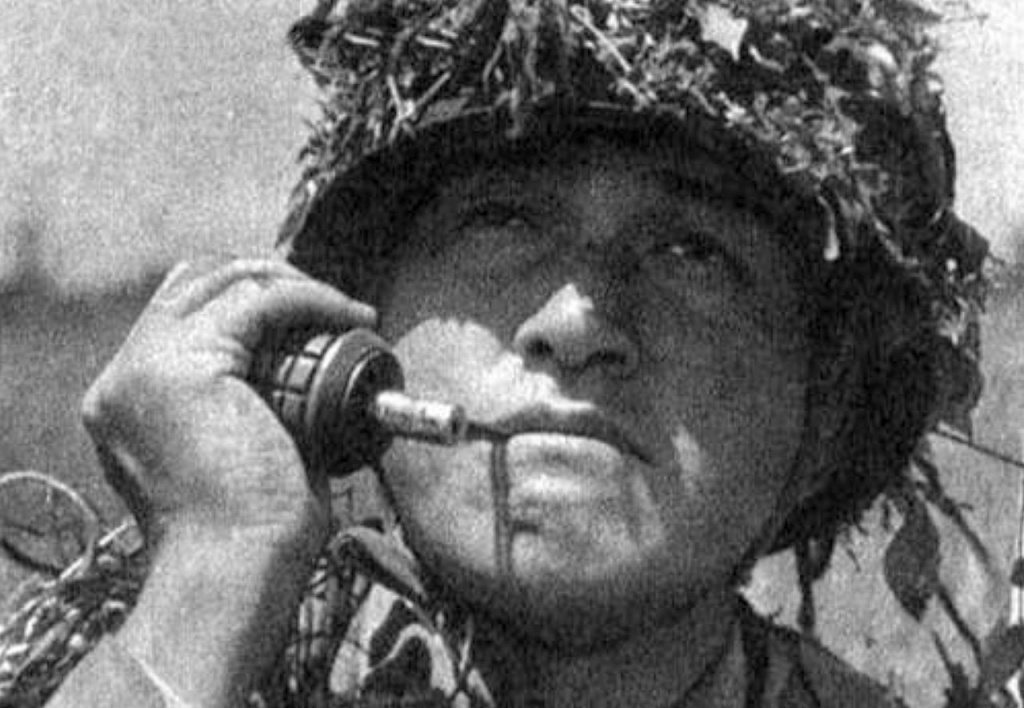
Accompanying these items is a Nambu pistol holster, designed to carry either the Type 14 or Type 94 Nambu pistol. These sidearms were typically issued to officers and non-commissioned officers, marking both authority and responsibility. While not a primary weapon, the pistol served as a last line of defense and a symbol of leadership. The holster itself, worn on the belt or equipment rig, reflects the practical need for accessibility while also identifying the role of the individual who carried it.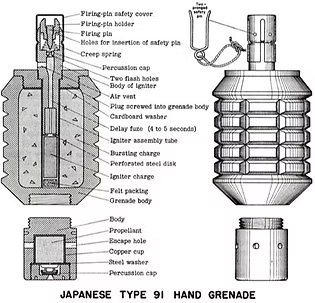
Displayed alongside are 6.5×50mm Arisaka cartridges, ammunition for the Type 38 rifle—one of the most widely used Japanese service rifles, particularly in the earlier years of the war. Each cartridge represents more than firepower; it represents limitation. Japanese soldiers often operated with restricted ammunition supply, especially as the war progressed and logistical networks broke down. Every round carried had to be accounted for, conserved, and used with purpose. In isolated positions,  resupply was uncertain, and what a soldier carried into battle might be all he would have.
Taken together, this field kit reflects a doctrine built around self-reliance and endurance. Japanese infantry were often expected to operate independently, sometimes for extended periods, with minimal support. This reality became increasingly severe as the war progressed, particularly on remote islands where units were cut off from reinforcement and supply. In these conditions, the equipment carried by the soldier became not just tools of war, but tools of survival.
The Pacific War placed extraordinary demands on the human body and mind. Heat, disease, hunger, and exhaustion were constant companions. Equipment like this was shaped by those conditions—used, worn, adapted, and relied upon in ways that went far beyond its original design.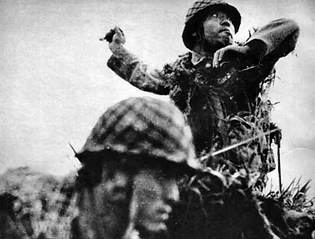
This display is not simply a collection of objects. It is a reflection of experience.
Preserved within the collection of Ghosts of the Battlefield, these artifacts connect us to the soldiers who carried them—men who fought not only an enemy, but an environment that tested the limits of endurance. It reminds us that in the Pacific, survival was never guaranteed, and every piece of equipment carried a purpose measured not in convenience, but in necessity.