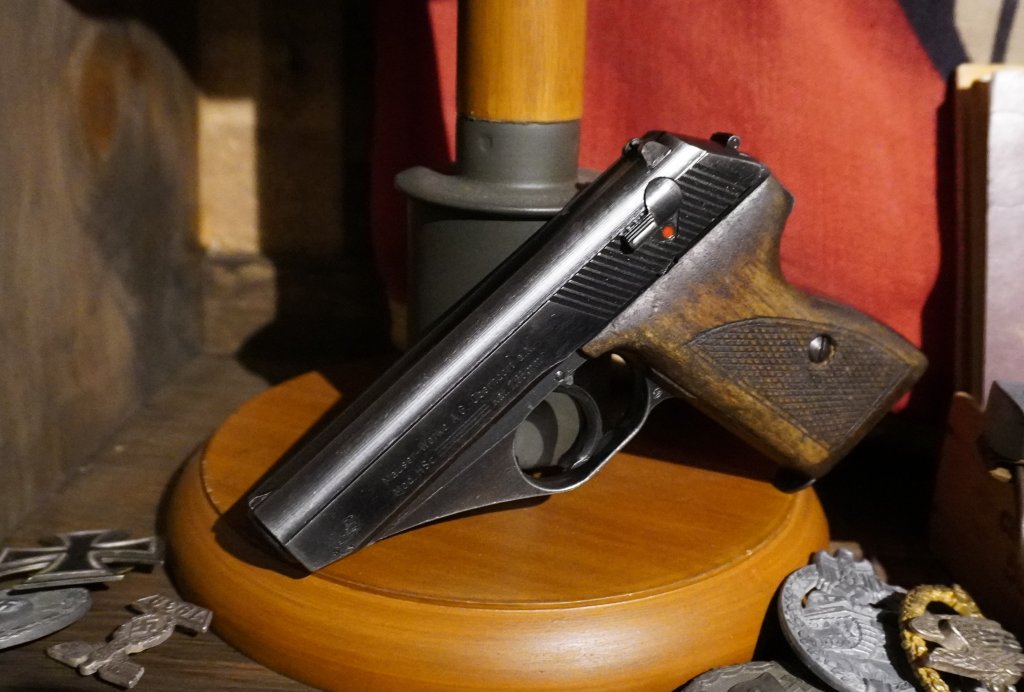
By the time the Second World War reached its height, the German military had already fielded some of the most recognizable sidearms of the era. Pistols such as the Luger P08 and Walther P38 were designed with the battlefield in mind—military weapons built for officers and combat roles. Yet alongside these more prominent arms existed another pistol, one that served a different purpose and reflected a subtle shift in wartime needs: the Mauser HSc.
At first glance, the HSc appears unremarkable. Chambered in .32 ACP (7.65mm), it lacked the stopping power associated with larger-caliber service pistols. It was not designed to dominate engagements or serve as a primary weapon in combat. Instead, it was engineered with a different set of priorities—reliability, compactness, and ease of carry.
Introduced in the late 1930s, the Mauser HSc featured a sleek, streamlined profile with minimal external protrusions. Its smooth contours allowed it to be drawn cleanly from a holster or pocket without snagging, an important consideration in moments where hesitation could prove fatal. This design philosophy reflected an understanding that not all weapons of war were meant for open battle; some were intended to be carried quietly, close at hand, and ready when needed most.
As the war progressed, the HSc became widely issued to officers, police units, and rear-area personnel. It was particularly suited to roles where a full-sized sidearm was impractical or unnecessary. In this way, the pistol blurred the line between military and civilian firearm design, representing a broader shift toward simplified production and functional efficiency as Germany's industrial resources came under increasing strain.
The markings found on these pistols further connect them to the realities of wartime production. Many HScs bear German military acceptance stamps, including eagle proofs, which today serve as identifiers of origin and issue. Earlier examples often display higher levels of finish and craftsmanship, while late-war pistols frequently exhibit rougher machining and simplified construction—visible evidence of a nation under pressure, struggling to maintain output as the war turned against it.
Despite its modest caliber, the HSc earned a reputation for reliability. Its compact size and dependable function made it a practical choice for those who carried it daily. Yet its limitations were equally clear. Compared to larger service pistols, it offered reduced stopping power, reinforcing its role as a defensive weapon rather than an offensive one.
For many who carried it, the Mauser HSc was not a weapon of first resort. It was a last line of defense—kept close, often unseen, and relied upon in moments of urgency. It represents a different dimension of warfare, one not defined by large-scale engagements, but by individual experience and personal survival.
Preserved within the collection of Ghosts of the Battlefield, the Mauser HSc stands as a reminder that not all weapons are meant to lead the charge. Some exist for the moments when everything else has failed—when reliability, simplicity, and immediate access become the only things that matter.

