From Vietnam War, Rifles of the Vietnam War: Evolution of the Kalashnikov System
Simplicity, Firepower, and the Weapons of Close Combat
March 26, 2026

 The Vietnam War was fought in an environment that changed the way soldiers carried, used, and valued their weapons. Dense jungle, sudden ambushes, narrow trails, and short lines of sight placed a premium on reliability and immediate firepower. In this kind of war, the rifle was not simply a standard-issue arm. It was the soldier’s constant companion in a landscape where contact with the enemy could come without warning and at extremely close range.
The three rifles displayed here reflect that reality and the growing influence of Soviet-designed small arms during the conflict.
At the top is the SKS, a semi-automatic carbine that represented an important step between older infantry rifles and the modern assault rifle. Chambered in 7.62×39mm, it offered greater speed of fire than traditional bolt-action weapons while retaining a simple and dependable design. Though it lacked fully automatic capability, the SKS remained widely used in Vietnam, particularly in the earlier phases of the war and among forces for whom ruggedness and ease of maintenance mattered more than volume of fire alone.
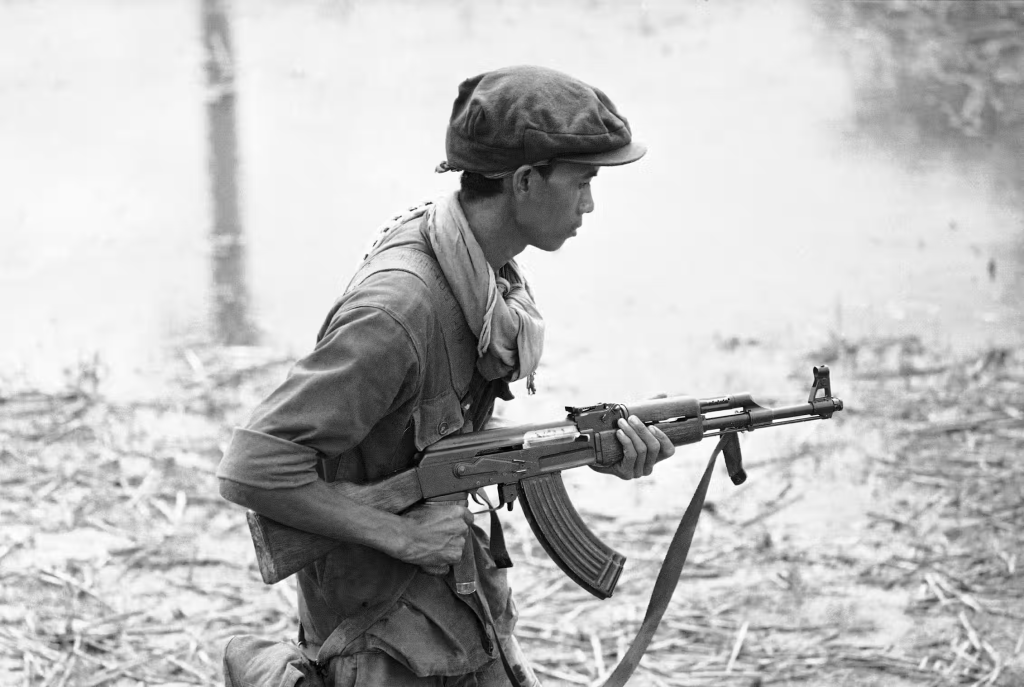
Beneath it is an AK-pattern rifle, a weapon type that became one of the defining symbols of the Vietnam War. Compact, durable, and capable of automatic fire, the AK platform was exceptionally well suited to the conditions of Southeast Asia. Mud, rain, and humidity could cripple more delicate systems, but the Kalashnikov design earned its reputation through simplicity and resilience. This particular example, with its modified foregrip configuration, also reflects a broader truth about the weapon’s history: the AK platform was widely produced, adapted, and altered across many regions and conflicts, resulting in numerous variations in appearance and handling.
At the bottom is another AK-pattern rifle with a folding stock, emphasizing portability and maneuverability. In a war where weapons had to be carried through thick vegetation, into tunnels, across rivers, and along narrow jungle paths, compactness mattered. A folding-stock configuration made the rifle easier to transport and use in confined spaces, particularly for troops requiring mobility in difficult terrain.
 Together, these rifles represent more than technical development. They reflect a style of warfare built around short, violent engagements where reliability often mattered more than refinement. For North Vietnamese and Viet Cong forces, such weapons offered practical advantages in both guerrilla and conventional operations. For American and allied troops, they became familiar battlefield adversaries—recognized by their distinctive shape, sound, and effectiveness in the kind of fighting that defined Vietnam.
These firearms also illustrate a larger shift in infantry doctrine during the mid-20th century. The move away from long, heavy rifles toward compact weapons firing intermediate cartridges reflected the growing importance of controllable automatic fire at close and medium ranges. Vietnam made that shift unmistakable.
Preserved within the collection of Ghosts of the Battlefield, these rifles serve as a reminder that the war in Vietnam was fought not in abstract strategy, but in mud, heat, foliage, and fear. They connect us to the reality of a conflict where the effectiveness of a weapon was measured not only by its design, but by whether it would function in the instant it was needed most.