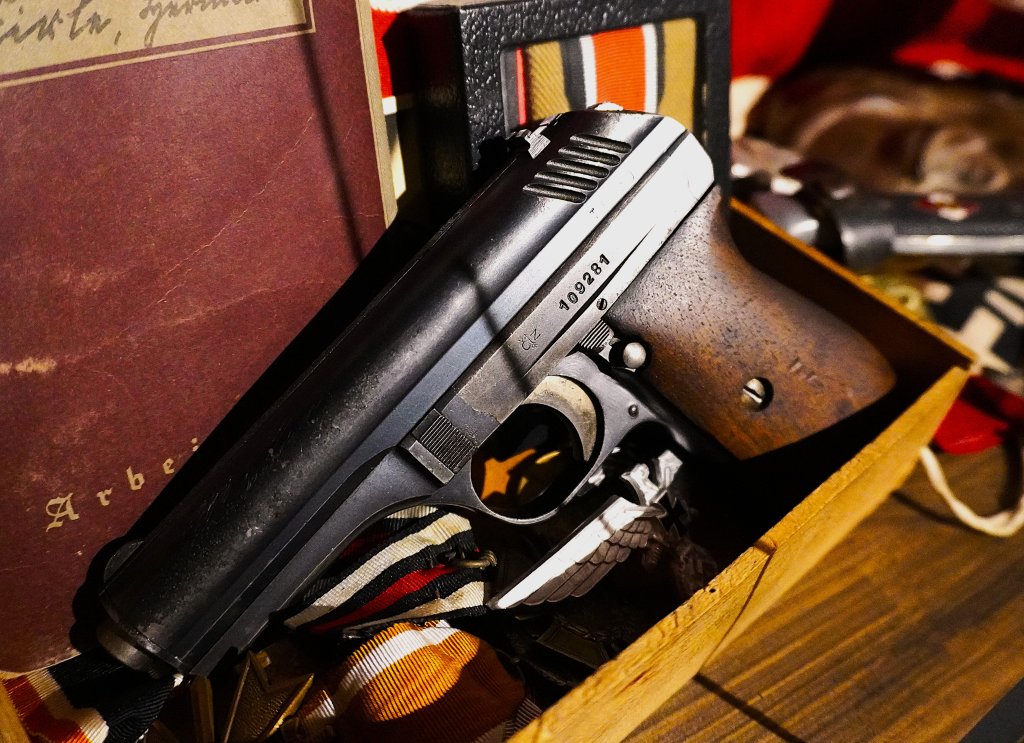
When Germany occupied Czechoslovakia in 1939, it did not simply seize territory—it absorbed an industrial base. Among the most valuable assets were the arms factories of ÄŒeská zbrojovka (CZ), whose designs and production capacity would be redirected to serve the German war effort. The CZ Model 27, originally developed in the interwar years, became one of the many weapons produced under occupation and issued throughout the Third Reich.
Known in German service as the Pistole 27(t)—with the “t†denoting its Czech origin—the pistol was chambered in .32 ACP (7.65mm), a cartridge widely used across Europe for police and military sidearms. Its simple blowback design emphasized reliability and ease of manufacture, qualities that became increasingly important as wartime pressures mounted.
Unlike more complex pistols such as the Luger P08 or even the Walther P38, the CZ Model 27 was straightforward in both construction and operation. This simplicity made it well suited for large-scale production, particularly in an environment where efficiency and output were critical. As a result, it was widely issued to German police units, security forces, and rear-area personnel, as well as to certain military roles where a compact and dependable sidearm was required.
The markings found on these pistols reflect their complex history. Many examples bear German military acceptance stamps, including Waffenamt markings, indicating inspection and approval under German authority. These stamps serve as tangible evidence of the weapon's transition from a national product of Czechoslovakia to a tool of an occupying force.
As the war progressed, production conditions changed. Early examples of the CZ Model 27 often display a higher level of finish, while later wartime pistols show signs of simplified machining and reduced refinement. These differences mirror the broader trajectory of German industry during the conflict—shifting from precision and quality toward expediency and survival.
In terms of performance, the CZ Model 27 was reliable and easy to maintain, making it a practical sidearm for those who carried it daily. However, like many pistols chambered in .32 ACP, it offered limited stopping power compared to larger-caliber weapons. Its role was not to serve as a primary combat weapon, but as a defensive tool—one that could be relied upon in moments of immediate need.
This pistol represents more than a firearm; it reflects the realities of occupation and the integration of captured industry into a wartime economy. It stands at the intersection of national identity, industrial capability, and military necessity.
Preserved within the collection of Ghosts of the Battlefield, the CZ Model 27 offers a tangible connection to this complex history. It reminds us that the tools of war are often shaped not only by those who design them, but by the circumstances under which they are produced—and the shifting control of the world around them.

