USS Indianapolis: From Fleet Flagship to One of the U.S. Navy’s Greatest Tragedies
Contrary to one enduring version of the story, Indianapolis was not deliberately prevented from sending a distress call because her atomic-bomb mission was secret. That mission was already complete.
July 29, 2026

The story of USS Indianapolis (CA-35) is often reduced to a few terrible days in the summer of 1945: a secret mission, two torpedoes, hundreds of men stranded in the Pacific, sharks, and a rescue that came far too late. But Indianapolis was far more than the ship that carried components of the atomic bomb and then disappeared beneath the Philippine Sea. She had been one of the most recognizable heavy cruisers in the United States Navy, a presidential ship, a fleet flagship, and a combat veteran whose guns had supported American forces from the Aleutians to Okinawa. By the time she was lost, Indianapolis and her crew had already fought through years of war and earned ten battle stars. Understanding the tragedy of her sinking means first understanding the ship that was lost.
USS Indianapolis was a Portland-class heavy cruiser, one of two ships of the class built during the period when international naval treaties attempted to limit the size and power of the world's fleets. She was laid down by the New York Shipbuilding Corporation at Camden, New Jersey, on March 31, 1930, launched on November 7, 1931, and commissioned on November 15, 1932. At approximately 610 feet long with a beam of 66 feet and a standard displacement of about 9,800 tons, she was a large, fast warship capable of approximately 32 knots. Her main battery consisted of nine 8-inch guns mounted in three triple turrets, backed by eight 5-inch guns and, as the war progressed, an increasingly formidable battery of smaller antiaircraft weapons.
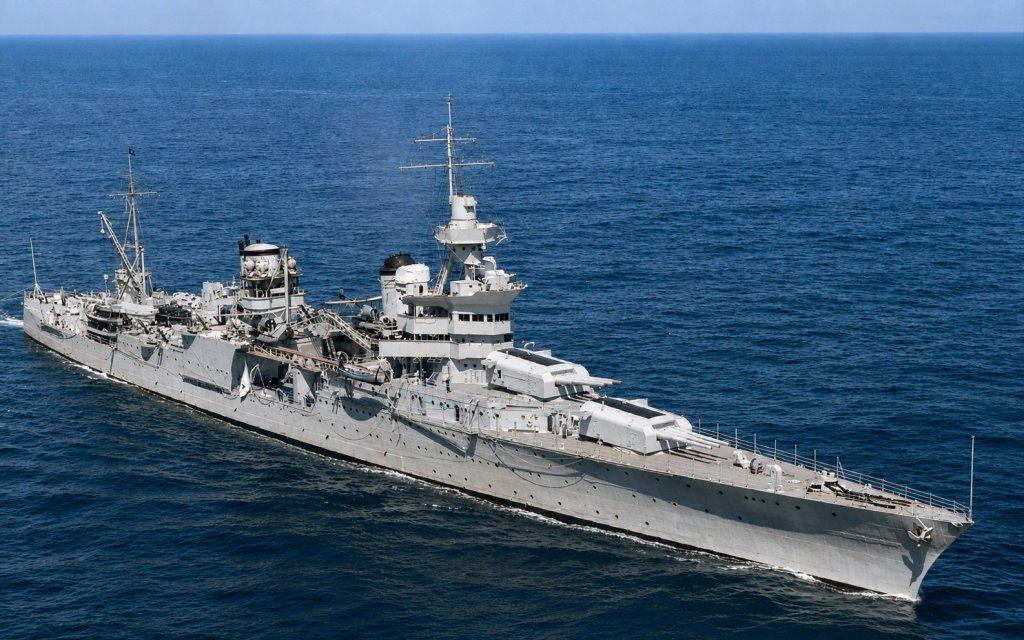
Indianapolis reflected the compromises built into the American "treaty cruiser" concept. Naval architects had to combine long range, high speed, heavy guns, command facilities, and protection while staying near treaty-imposed displacement limits. The result was a ship capable of operating across the enormous distances of the Pacific and powerful enough to engage enemy cruisers or bombard positions ashore, but without the massive protection of a battleship. Speed and firepower mattered enormously, and Indianapolis possessed both. Her size and communications facilities also made her particularly useful as a flagship, a role she would repeatedly perform during both peace and war.
During the 1930s, Indianapolis became something of a showpiece for the Navy. President Franklin D. Roosevelt embarked aboard her in 1933, and the cruiser later served as the reviewing platform during the 1934 fleet review off New York. Roosevelt again traveled aboard Indianapolis in 1936 during his "Good Neighbor" cruise to South America. She also served as flagship of the Navy's Scouting Force for much of her prewar career. Long before the name Indianapolis became associated with catastrophe, she represented American naval power during a period when the United States was gradually preparing for a conflict few hoped would come.
When Japan attacked Pearl Harbor on December 7, 1941, Indianapolis was not in the harbor. She was conducting a simulated bombardment exercise near Johnston Island. She immediately joined the search for the Japanese carrier force before returning to Pearl Harbor on December 13. Her first wartime actions came early in 1942. In February, she was operating with American forces south of Rabaul when Japanese bombers attacked, and in March she participated in operations connected with the carrier strikes against Lae and Salamaua in New Guinea. From there her war moved north to the Aleutians, where she used her 8-inch guns against Japanese positions at Kiska and later participated in the campaign to retake Attu.
By 1943 and 1944, Indianapolis was increasingly tied to the central Pacific offensive and Admiral Raymond Spruance. As Spruance's flagship, she became part of the command center for one of the most powerful naval forces ever assembled. The cruiser supported operations through the Gilberts and Marshalls and was present as American forces drove westward through the Pacific. Her guns bombarded Japanese positions while her flag spaces and communications equipment helped Spruance direct an enormously complicated combination of carriers, battleships, cruisers, destroyers, transports, and amphibious forces.
During the Marianas campaign in 1944, Indianapolis supported the assault on Saipan and took part in the operations surrounding the Battle of the Philippine Sea, the enormous carrier engagement remembered for the destruction inflicted on Japanese naval aviation. She returned to bombard Saipan, operated off Tinian and Guam, and later supported operations in the Palaus. By the end of the war, her record included service in the Aleutians, Gilberts, Marshalls, Carolines, Marianas, Iwo Jima, and Okinawa. She earned ten battle stars for World War II service.
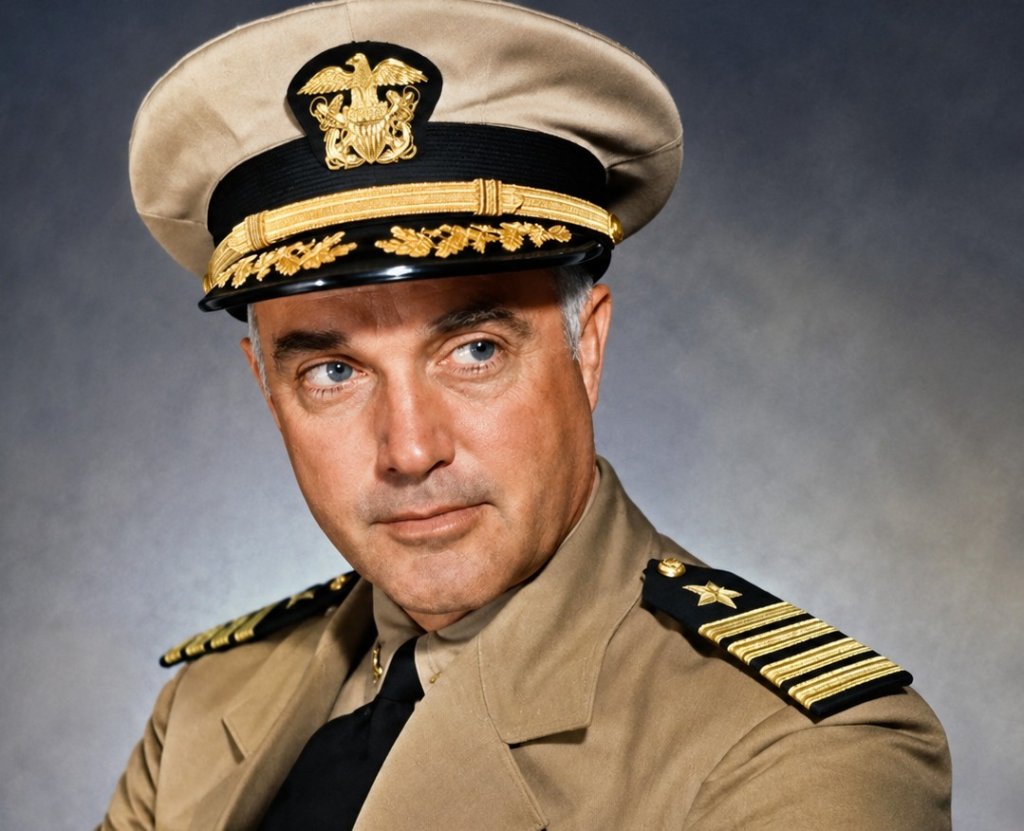 Command of Indianapolis passed to Captain Charles Butler McVay III on November 18, 1944. McVay was no inexperienced officer handed a major warship at the end of the conflict. A 1920 graduate of the U.S. Naval Academy, he had served aboard USS Cleveland during the North African landings and earned the Silver Star for his actions in the Solomon Islands. He later chaired the Joint Intelligence Staff in Washington before receiving command of Indianapolis. Under McVay, the cruiser supported the fighting at Iwo Jima and operations against the Japanese home islands before moving south toward Okinawa.
On March 31, 1945, the day before the invasion of Okinawa, the war nearly claimed Indianapolis. A Japanese aircraft dove toward the cruiser. Antiaircraft fire struck it and the airplane itself caused comparatively little damage when it crashed, but before going down the pilot released a bomb. It passed through the ship, penetrating decks, crew spaces and fuel tanks before exploding beneath the hull. The underwater blast tore two large holes in the bottom of Indianapolis, killed nine members of the crew, wounded others, and damaged her propeller shafts and other systems. Despite the damage, the cruiser remained afloat. After emergency repairs she made the long voyage back across the Pacific under her own power to Mare Island Navy Yard in California.
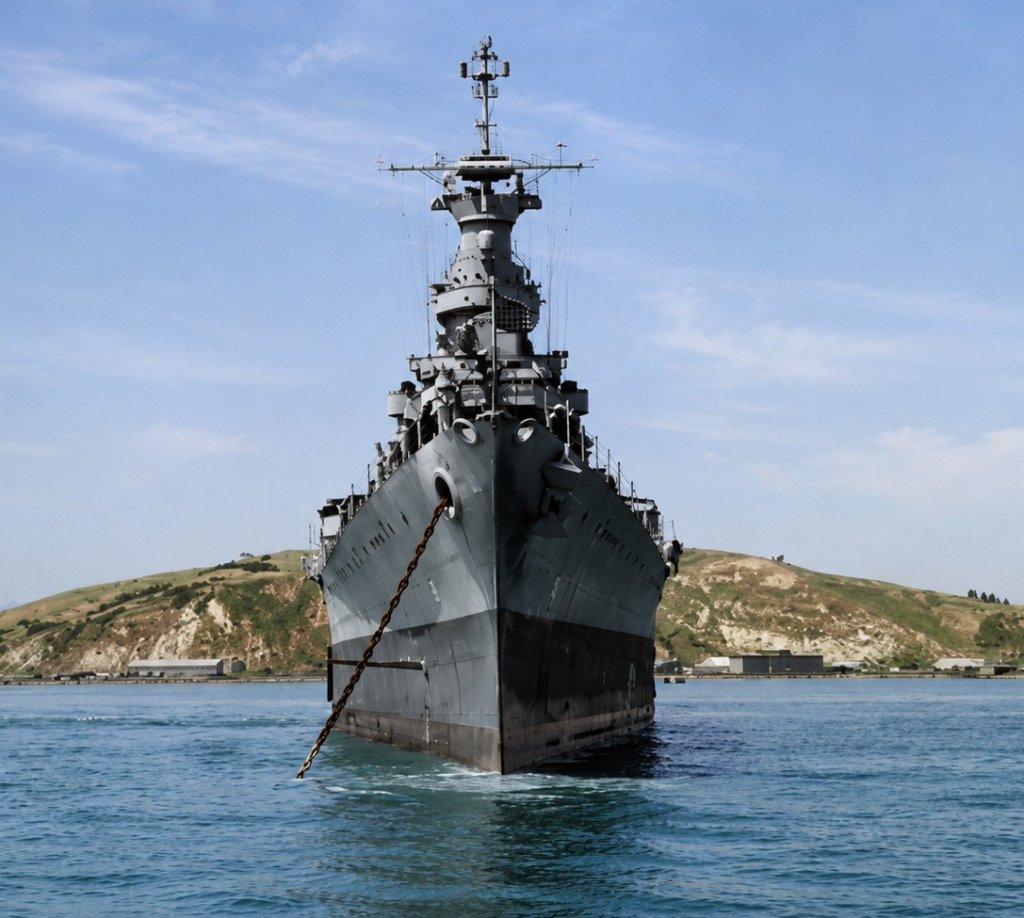 The repair period at Mare Island placed Indianapolis in position for the mission that would forever connect her name to the end of World War II. Her repairs were completed in July 1945, but instead of receiving the normal post-repair training period, Indianapolis was given an urgent assignment. On July 16 she left the San Francisco area carrying an extraordinarily secret cargo for the island of Tinian. Even Captain McVay and most of his crew were not told exactly what they were carrying.
The cargo included critical components and nuclear material for the Little Boy atomic bomb. Indianapolis crossed from the West Coast to Pearl Harbor in 74.5 hours, breaking the previous record for the passage, refueled, and continued toward the Marianas. She reached Tinian on the morning of July 26, only ten days after leaving California. The sensitive cargo was quickly taken ashore. Eleven days later, on August 6, Little Boy would be dropped on Hiroshima. The crew of Indianapolis had completed one of the most important transportation missions of the war without fully knowing what they had carried.
With the mission complete, Indianapolis sailed to Guam and then received orders to proceed to Leyte in the Philippines. There, she was to prepare for further operations as the United States planned for what was still expected to be an invasion of Japan. Indianapolis departed Guam on July 28, traveling alone at approximately 17 knots.
The circumstances surrounding that voyage would later become the subject of enormous controversy. American intelligence knew Japanese submarines remained at sea, but the intelligence picture was far less straightforward than later retellings sometimes suggest. Messages concerning the submarine I-58 had been intercepted, but American intelligence had incorrectly assessed that I-58 might already have been sunk. McVay was not given every piece of submarine information available to higher commands, including information concerning the recent loss of USS Underhill, although that attack had occurred hundreds of miles from Indianapolis's intended route. The contemporary assessment of submarine danger along the route assigned to Indianapolis was relatively low. She consequently made the voyage without an escort.
During the night of July 29-30, Japanese submarine I-58, commanded by Mochitsura Hashimoto, found her.
Indianapolis was steaming through the Philippine Sea when changing weather conditions gave Hashimoto an opportunity. The moon appeared through the clouds and illuminated the silhouette of the cruiser. I-58 maneuvered into attack position and fired a spread of six Type 95 torpedoes.
Shortly after midnight on July 30, two struck.
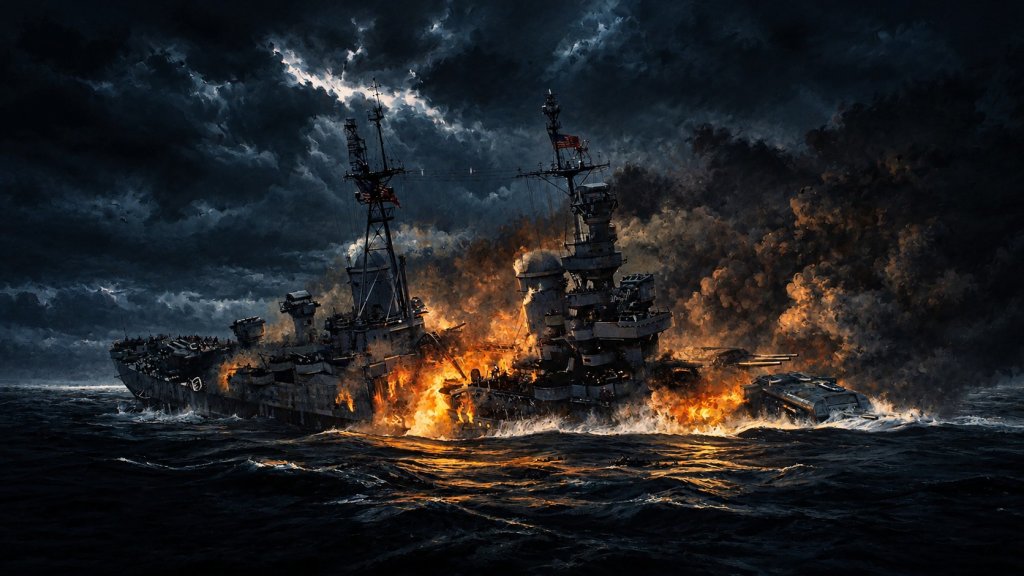
The first hit Indianapolis forward, tearing into the bow. The second struck farther aft on the starboard side near fuel tanks and other critical spaces. Electrical power failed. Communications were devastated. Internal compartments flooded rapidly, and the ship developed a severe list. What had been a 610-foot heavy cruiser only minutes earlier became a dying ship filled with darkness, smoke, ruptured piping, wreckage, burning fuel, and men desperately trying to reach the weather decks.
There was almost no time.
Indianapolis went down in approximately twelve minutes.
Men jumped or were thrown into the sea. Some life rafts and floater nets were released, but the speed of the sinking made an orderly evacuation impossible. Captain McVay remained aboard until he was washed into the water as the ship disappeared. Roughly 300 men are believed to have died in the explosions or gone down with Indianapolis. Hundreds more survived the actual sinking only to find themselves scattered across miles of open ocean in the darkness.
Their ordeal was only beginning.
Many had nothing more than a kapok life jacket. Others clung to floater nets, wreckage, or overcrowded rafts. Some had been badly burned or wounded during the sinking. There was almost no fresh water and very little food. The tropical sun beat down during the day, while nights brought cold, exhaustion, and confusion. Oil coated the survivors. Saltwater sores developed. Men became desperately dehydrated. Some drank seawater, accelerating delirium and physical collapse. Survivors later described hallucinations in which men imagined islands, ships, or sources of fresh water that did not exist.
And there were sharks.
Shark attacks became the most famous element of the Indianapolis story, especially after the disaster entered popular culture, but the reality was broader and in many ways even more terrible. Survivors did witness attacks, and some men were unquestionably killed or mutilated by sharks. Yet exposure, dehydration, injuries, drowning, and the effects of drinking seawater were also major causes of death. The exact number killed by sharks can never be known. The men were scattered over a large area, and each group experienced the ordeal differently. What is certain is that hour after hour men disappeared until groups that had initially contained dozens or hundreds became smaller and smaller. Naval History and Heritage Command research notes that many casualties resulted from dehydration and overexposure.
What makes the tragedy particularly painful is that no rescue force was searching for them.
Contrary to one enduring version of the story, Indianapolis was not deliberately prevented from sending a distress call because her atomic-bomb mission was secret. That mission was already complete. Instead, the ship's communications were catastrophically damaged almost immediately. Men attempted to transmit distress messages, but the subsequent Court of Inquiry concluded that no message was successfully transmitted from the sinking cruiser because of damage to radio equipment and loss of power. At the same time, failures and misunderstandings within the Navy's movement-reporting system meant Indianapolis was not immediately reported missing when she failed to reach Leyte.
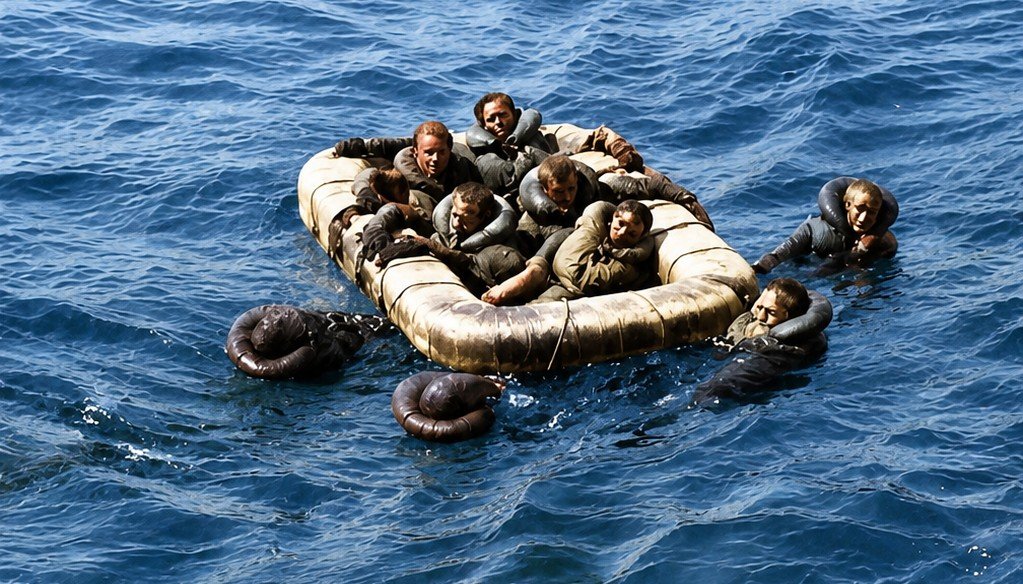
The result was extraordinary. Hundreds of American sailors and Marines were dying in the Philippine Sea, and for days the Navy did not know they were there.
The breakthrough finally came on August 2. Lieutenant Junior Grade Wilbur "Chuck" Gwinn was flying a PV-1 Ventura on a routine patrol from Peleliu when he noticed a large oil slick. Descending to investigate what he initially thought might indicate an enemy submarine, Gwinn saw men in the water. His crew dropped emergency equipment and reported the position. He had accidentally discovered the survivors of Indianapolis after they had already spent roughly three and a half days at sea.
Once their existence was known, the rescue effort moved quickly. Aircraft rushed to the area carrying rafts, supplies, and equipment. Lieutenant Robert Adrian Marks arrived in a PBY Catalina flying boat. After seeing men struggling in the water and realizing surface ships were still hours away, Marks and his crew made the dangerous decision to land their aircraft on the open sea. The landing damaged the Catalina badly enough that it would never fly again, but Marks began taking men aboard. When there was no space left inside, survivors were placed on the wings. Fifty-six men were taken aboard the aircraft.
The first surface rescue vessel to reach the scene was the destroyer escort USS Cecil J. Doyle. Her commanding officer, Lieutenant Commander W. Graham Claytor Jr., ordered the ship's searchlight pointed vertically into the night sky while still approaching the survivor area. It was a risk in wartime waters, but the beam gave the men scattered below something they had not possessed for days: visible proof that somebody was coming. Cecil J. Doyle recovered Marks, his crew, and survivors from the crippled Catalina and then continued pulling men from the water. USS Bassett, USS Ringness, USS Register, USS Ralph Talbot, USS Dufilho, and other ships joined the rescue and search operation. McVay himself was recovered with nine other men from a raft on August 3.
The final accounting is staggering. Modern Naval History and Heritage Command research establishes that 1,195 sailors and Marines were aboard Indianapolis on her final voyage. Only 316 survived. Eight hundred seventy-nine men were lost. It remains the deadliest loss of a U.S. Navy ship at sea.
For Captain McVay, surviving the ocean did not end the ordeal.
A Court of Inquiry convened on Guam on August 13, only days after his rescue. Its job was not merely to determine why Indianapolis sank, but also why the ship's disappearance had gone unnoticed for so long. The investigation examined the decision not to zigzag, the failure of distress communications, the routing of Indianapolis, intelligence information, watch conditions aboard the cruiser, and the procedures at Leyte that failed to trigger an immediate alarm when the ship did not arrive.
The Court concluded that McVay bore contributory responsibility because Indianapolis was not zigzagging and initially criticized him concerning the distress message. It also identified failures elsewhere, including the failure at Tacloban to act on the cruiser being overdue and a communications failure that prevented an important dispatch from reaching the officer responsible for the training Indianapolis was to undertake after arriving at Leyte. The disaster was therefore never as simple as one captain making one bad decision. It involved a chain of circumstances, assumptions, communications failures, and procedures that failed catastrophically when the unexpected happened.
Nevertheless, McVay was ordered before a general court-martial in Washington in December 1945. He faced two charges. One accused him of negligence in hazarding his ship by failing to zigzag. The other accused him of culpable inefficiency in failing to issue and carry out a timely abandon-ship order.
He was acquitted of the abandon-ship charge.
He was convicted of failing to zigzag.
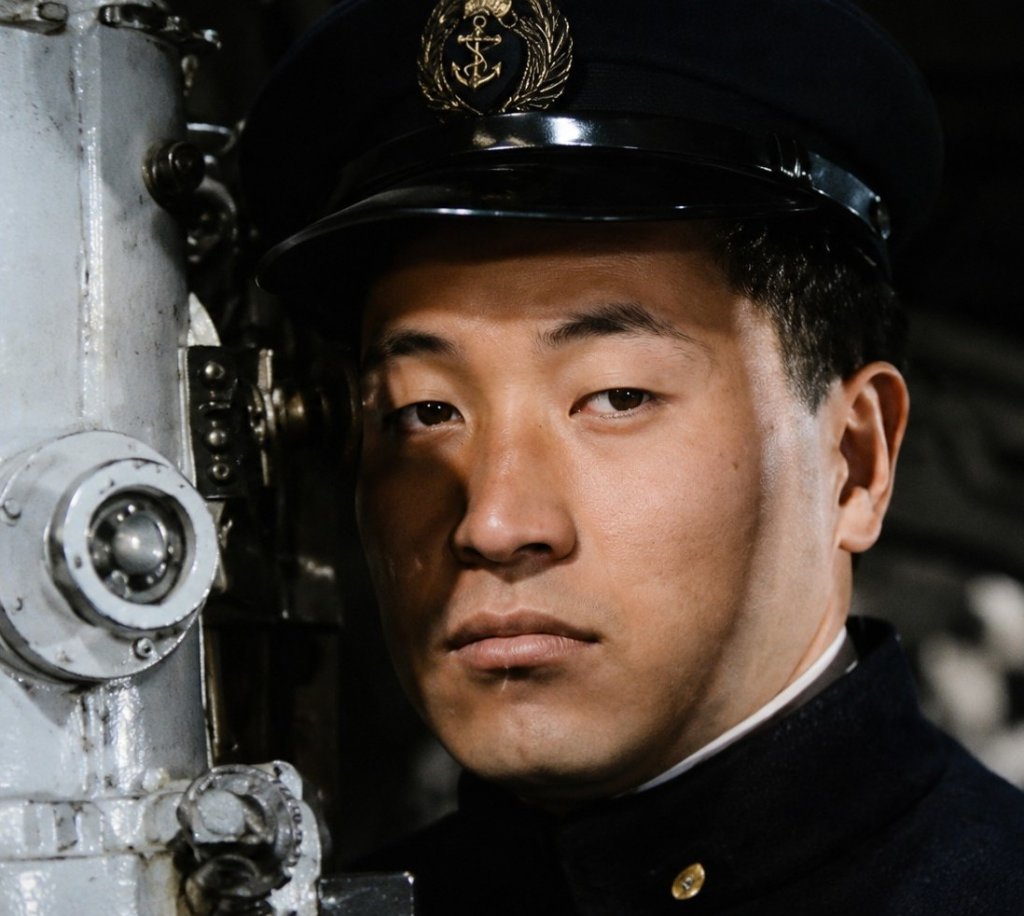
The case became controversial almost immediately, particularly because the Navy chose to prosecute McVay for failing to zigzag while also calling the very man who had sunk Indianapolis as a witness. Mochitsura Hashimoto, commander of the Japanese submarine I-58, was brought to Washington to testify about the attack. His presence at the court-martial was extraordinary in itself: only months after the war ended, an enemy submarine commander was being asked to help determine whether an American captain had been negligent in the loss of his own ship.
Hashimoto’s testimony did not provide the simple answer the prosecution may have hoped for. He explained that a zigzagging target would have required him to make adjustments in positioning and timing, but he did not indicate that zigzagging would necessarily have prevented the attack. By the time I-58 had Indianapolis in sight, Hashimoto had achieved an extremely favorable firing position. The cruiser was visible at relatively close range, intermittently silhouetted by moonlight, and the submarine was able to maneuver into position before launching a spread of six torpedoes. Hashimoto later maintained that, given his position and the conditions of the attack, he believed he still would have been able to hit Indianapolis even if she had been zigzagging.
That point became central to the controversy surrounding McVay’s conviction. Zigzagging was a recognized defensive measure intended to make a ship more difficult for a submarine to track and to complicate the calculation of a torpedo firing solution, but it was not a guarantee against attack. A submarine commander who had already gained a strong firing position could still adjust to changes in course, especially when attacking a large cruiser from relatively close range. McVay had also been given discretion to zigzag according to conditions, rather than being ordered to do so continuously, and visibility had varied during the night.
For many survivors and later historians, this made the decision to place so much responsibility on McVay difficult to justify. Indianapolis had been sent across dangerous waters without an escort, information concerning enemy submarine activity had not been fully passed to her captain, and the Navy’s own reporting system failed to raise an immediate alarm when the cruiser did not arrive at Leyte. Against that background, holding McVay criminally responsible for failing to zigzag appeared to reduce a complicated disaster involving numerous failures into the actions of a single officer.

The central question was therefore never whether zigzagging might have made Indianapolis a more difficult target. It probably would have complicated Hashimoto’s attack to some degree. The far more important question was whether anyone could say with certainty that zigzagging would have saved the ship. Hashimoto’s own testimony made that impossible to establish. He had placed I-58 in an excellent attack position, fired six torpedoes, and struck Indianapolis twice. The loss of the cruiser was the result of a successful enemy attack combined with a much broader chain of circumstances and failures, not simply one decision made by Captain McVay on the bridge that night.
The court sentenced McVay to the loss of 100 numbers in his temporary grade of captain and another 100 in his permanent grade of commander, affecting his seniority, but the court itself unanimously recommended clemency because of his distinguished record. Secretary of the Navy James Forrestal ultimately remitted the sentence in its entirety, and McVay returned to duty. He retired from the Navy in 1949 as a rear admiral
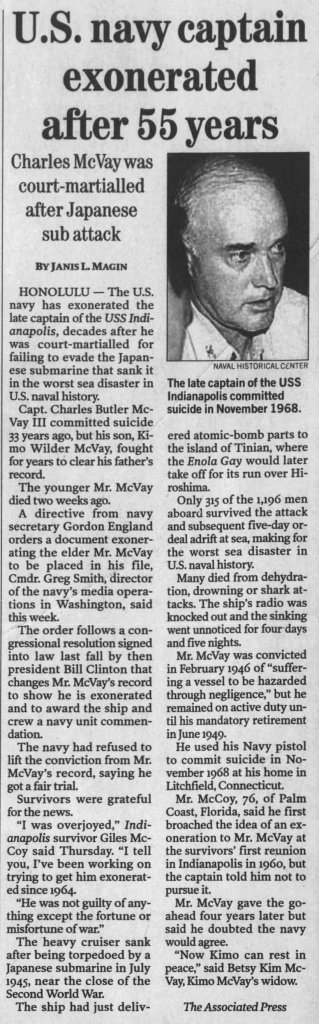 But an official remission of his sentence did not erase what had happened. For years McVay carried the weight of Indianapolis. Some families of those who died blamed him personally, and the controversy surrounding the court-martial followed him long after he left the service. McVay died by suicide in 1968.
The effort to clear his name continued without him. Survivors of Indianapolis became some of McVay's strongest defenders, joined decades later by historians, veterans, and members of Congress. In 2000, Congress adopted a provision stating that the American people should recognize McVay's lack of culpability for the loss of Indianapolis and that his military record should reflect his exoneration. In 2001, Secretary of the Navy Gordon England ordered a copy of that congressional provision placed in McVay's official personnel record. The action did not erase the historical fact that the 1945 court-martial occurred, but it formally placed the government's later judgment alongside that conviction: Captain McVay should not bear the blame for the loss of his ship and hundreds of his men.
Indianapolis herself remained undiscovered for more than seventy years. In August 2017, an expedition funded by Paul Allen located the wreck on the floor of the Pacific approximately 5,500 meters—about 18,000 feet—below the surface. The discovery finally provided a physical resting place for a ship whose final position had remained uncertain since 1945.
Yet the Indianapolis story should never be remembered only for the way she died. She had spent years at war before those twelve minutes on July 30, 1945. Her sailors had fought Japanese aircraft, endured bombardments, supported Marines and soldiers ashore, crossed thousands upon thousands of miles of Pacific Ocean, and participated in the campaigns that carried American forces from the defensive days of 1942 to the doorstep of Japan. Nine of her men had already been killed off Okinawa before her final voyage ever began. Her last crew successfully completed a mission of extraordinary importance and was heading back toward the war when fate placed I-58 in its path.
The loss of USS Indianapolis is ultimately not one story but several bound together. It is the story of a powerful warship designed in the uneasy years between two world wars. It is the story of a veteran cruiser and the men who carried the Pacific war westward. It is the story of Captain Charles McVay, a decorated naval officer who survived the destruction of his ship only to spend the remainder of his life beneath its shadow. It is the story of nearly nine hundred men who never came home and 316 who somehow survived an ordeal almost beyond comprehension. It is also a story of institutional failure, because the greatest tragedy was not simply that Indianapolis was torpedoed in wartime. Warships are lost in war. The deeper tragedy was that her surviving crew disappeared into the Pacific and, for days, no one knew to look for them.
That is why Indianapolis still matters. Her story is not simply about torpedoes, sharks, an atomic bomb, or even a ship. It is about the sailors and Marines aboard her, the decisions that placed them there, the extraordinary endurance of those who survived, and the responsibility to remember those who did not.
For USS Indianapolis and the 879 men lost with her and in the sea that followed, the final chapter is remembrance.
Historical Information Provided By (Naval History and Heritage Command)