Operation Arc Light: The Role of B-52 Bombers in the Vietnam War*
To enhance their conventional bomb capacity, Project Big Belly retrofitted B-52Ds to carry up to 30 tons of conventional bombs.
December 21, 2024

 For men on the ground in Vietnam, an approaching air strike usually announced itself. Jets screamed overhead. Helicopters could be heard long before they arrived. Artillery gave its own warning as rounds passed overhead toward the target. An Arc Light strike could be different. Somewhere miles above the jungle, B-52 Stratofortresses approached at altitudes where men below often could neither see nor hear them. There might be no aircraft engine growing louder and no obvious warning in the sky. Then the ground began to erupt.
That was the peculiar terror of Operation Arc Light.
The B-52 had not been designed for this war. Boeing's enormous Stratofortress had entered service as a weapon of the Cold War, built primarily to carry nuclear weapons deep into enemy territory. Its crews belonged to Strategic Air Command, an organization whose central mission revolved around deterrence and the possibility of a war with the Soviet Union. By the early 1960s, those crews trained for missions potentially involving nuclear weapons and targets thousands of miles from their bases. Vietnam gave the airplane a radically different job.
Instead of Soviet industrial centers or strategic military targets, B-52 crews would be sent against jungle base areas, supply dumps, infiltration routes, troop concentrations, bunkers, artillery positions, and enemy forces massing only a few miles from American or South Vietnamese troops. A bomber created to help deter a nuclear war was about to become an immense conventional artillery piece in the sky.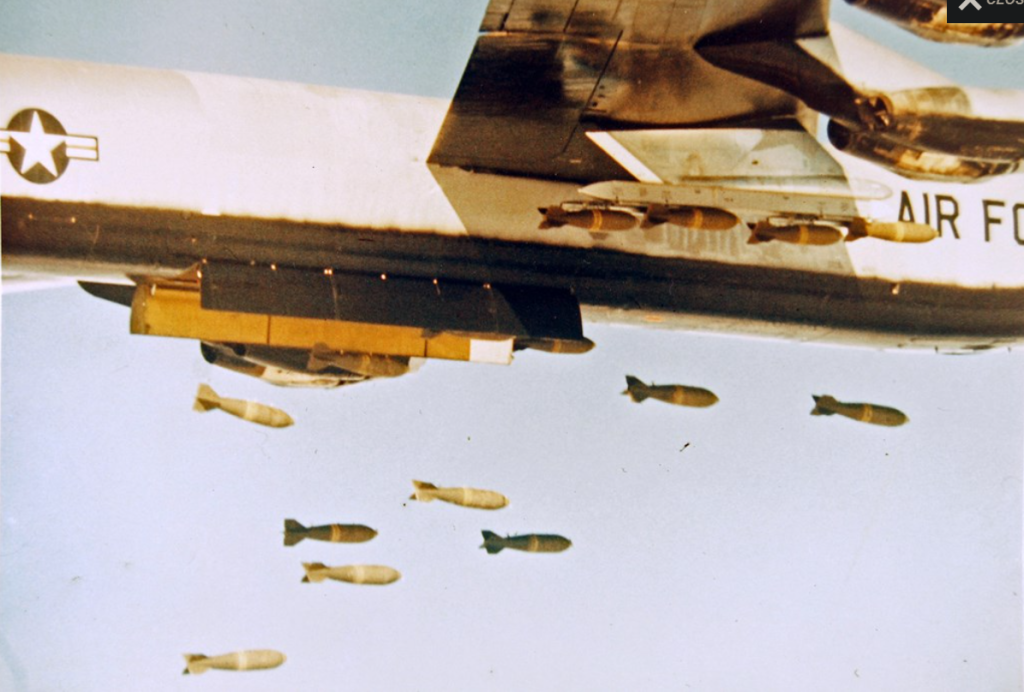
The transformation began in earnest on June 18, 1965. Thirty B-52Fs took off from Andersen Air Force Base on Guam for the first Arc Light combat mission, aimed at a Viet Cong base area in South Vietnam. The bombers carried more than 1,500 conventional bombs between them. Even before they reached Vietnam, the mission demonstrated that flying such a large force across thousands of miles of ocean was not simply a matter of pointing the aircraft toward a target and opening the bomb bay. During the aerial-refueling phase, two B-52s collided over the South China Sea. Eight crewmen were killed and another was listed as missing. Another bomber developed mechanical problems and diverted. Other aircraft experienced equipment difficulties before reaching the target. The surviving bombers continued toward South Vietnam and dropped more than 1,200 bombs.
The immediate results were underwhelming. Reconnaissance teams found relatively little evidence of enemy casualties, and critics questioned the wisdom of using one of America's most expensive strategic bombers against elusive guerrillas hidden in jungle terrain. It would have been easy for Arc Light to end as an expensive experiment. Instead, the Air Force and commanders in Vietnam learned how to use it. General William Westmoreland became one of the B-52's strongest advocates. The real value of the aircraft was not that it could hunt an individual squad moving beneath triple-canopy jungle. It could not. Its value was its ability to put an extraordinary amount of explosive force onto an area where intelligence indicated that enemy troops, headquarters, supplies, bunkers, or staging areas were concentrated. When used against the right target, a few B-52s could do something tactical aircraft could not easily duplicate.
Arc Light developed around the three-aircraft formation known as a “cell.” Flying roughly 25,000 to 30,000 feet above Southeast Asia, three B-52s could lay a devastating pattern of bombs across a large rectangular target area. Multiple cells could follow one another in waves, systematically covering a much larger area. As ground-based radar bombing techniques improved, crews could be guided to predetermined release points even at night or through weather that concealed the terrain below.
That created an extraordinary contrast between the men in the aircraft and the men underneath them.
To a B-52 crew flying high above cloud cover, the target could be little more than coordinates, instruments, timing, checklists, and a command to release. The crew might never see the jungle below and might never see the bombs explode. On the ground, there was nothing abstract about it. The first bombs struck before the sound of the aircraft could reach the target. Hundreds of explosions walked across the jungle. Trees were shattered or stripped bare. Bunkers collapsed. Equipment disappeared beneath churned earth. The concussion traveled beyond the actual impact area, and men miles away could feel the ground moving.
The airplane itself soon changed to fit the war.
 The early Arc Light missions were flown by B-52Fs, but the B-52D would become one of the aircraft most closely associated with the campaign. Under a modification program appropriately named Big Belly, the internal bomb bay of the B-52D was altered to carry vastly more conventional ordnance. A modified B-52D could carry as many as 84 500-pound bombs internally, with another 24 750-pound bombs carried beneath the wings. Other configurations substituted heavier bombs. A fully loaded Big Belly B-52D could deliver roughly 60,000 pounds of conventional ordnance in a single mission. It was an astonishing amount of firepower carried by one airplane.
The B-52Ds also acquired the visual appearance many veterans associate with Vietnam: dark undersides and camouflage across their upper surfaces instead of the earlier Strategic Air Command finish. They operated primarily from Andersen on Guam and U-Tapao in Thailand, with additional operations involving Kadena on Okinawa. U-Tapao became particularly valuable because its location in Thailand dramatically shortened the long flights required from Guam.
The crews remained part of Strategic Air Command. Many rotated into Southeast Asia from SAC units in the United States, bringing with them an organizational culture built around precision, checklists, readiness, and the unforgiving demands of nuclear operations. The mission had changed, but there was nothing casual about putting tens of thousands of pounds of bombs onto a target while friendly forces might be operating nearby.
By 1966 and 1967, Arc Light had grown from an experiment into a routine part of the war. B-52s struck enemy base areas, troop concentrations, supply routes, and infiltration corridors. They supported American troops in contact with enemy formations and worked over areas such as the A Shau Valley where North Vietnamese forces used difficult terrain and dense jungle to conceal men and supplies.
Then came Khe Sanh. In early 1968, thousands of North Vietnamese troops surrounded the isolated Marine combat base near the Laotian border. Artillery and rocket fire hammered the position while American commanders worried that the North Vietnamese might attempt to overwhelm the defenders. Air power became one of the principal means of keeping those enemy forces away from the perimeter.
Arc Light became part of the massive air campaign known as Operation Niagara.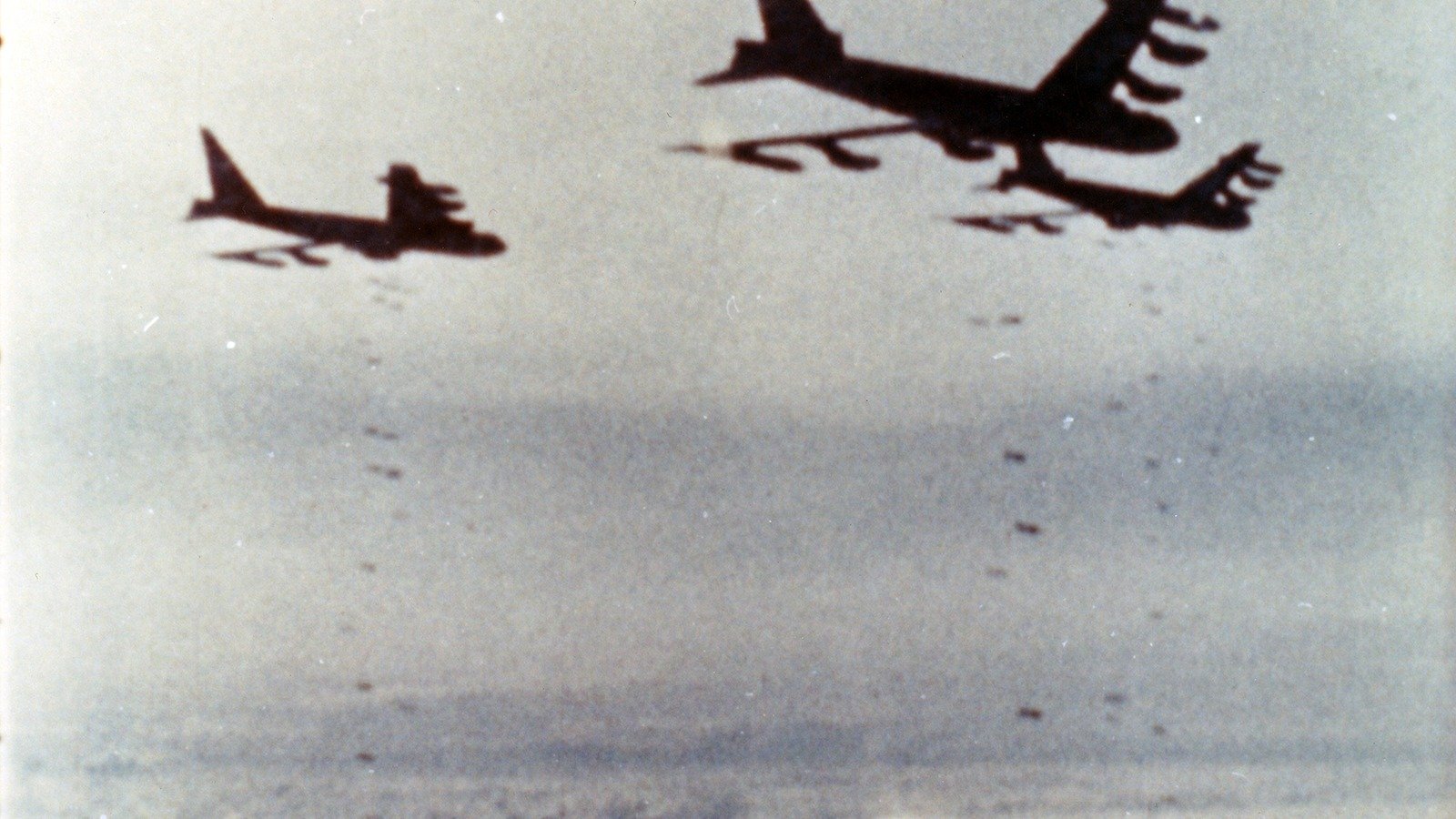
B-52s attacked troop concentrations, bunkers, assembly areas, supply positions, and suspected staging points around Khe Sanh around the clock. Ground radar could guide the bombers through the poor weather that frequently restricted other aircraft. Target information from the Marines and intelligence gathered around the battlefield allowed strikes to be shifted against suspected North Vietnamese concentrations. For Marines living beneath the siege, Arc Light was no longer an abstract Strategic Air Command mission being planned hundreds or thousands of miles away. They could feel it. Men at Khe Sanh later remembered the ground moving beneath them as B-52 strikes landed outside the perimeter. On Hill 881 South, Marines watched the effects of Arc Lights against North Vietnamese forces forming nearby. Captured enemy documents and prisoner accounts repeatedly indicated that B-52 attacks had a severe psychological effect as well as a physical one.
 That does not mean B-52s single-handedly “won” Khe Sanh, and the story becomes weaker rather than stronger when it is told that way. Marine, Navy, and Air Force tactical aircraft, artillery, sensors, reconnaissance, logistics, and the Marines defending the positions all played essential roles. But the B-52 added something extraordinary to that combined system: the ability to suddenly put enormous quantities of explosives onto a concentrated enemy force without the bomber ever being seen from the ground. At times the strikes were brought remarkably close to friendly positions. The distance between a strategic nuclear bomber and close support for Marines in fighting holes had become surprisingly small.
The same strange evolution continued as the war changed. Arc Light missions increasingly hit infiltration routes, logistics networks, base areas, and enemy concentrations in South Vietnam, Laos, and Cambodia. When North Vietnam launched its massive Easter Offensive in 1972, B-52s again became critical to forces trying to stop conventional North Vietnamese formations equipped with tanks, artillery, and large infantry units.
At An Loc and Kontum, the B-52 was used in a role that would have seemed almost absurd when the Stratofortress was conceived. Strategic bombers attacked enemy forces threatening South Vietnamese positions, sometimes with strikes brought close to defensive lines. American advisers and South Vietnamese commanders came to regard the immense bomb loads as one of the few weapons capable of breaking up large North Vietnamese troop concentrations before they could overwhelm the defenders.
The war had turned a nuclear deterrent into battlefield fire support.
The 1972 buildup also transformed Andersen Air Force Base. Under Operation Bullet Shot, Strategic Air Command rapidly sent additional B-52s, aircrews, maintenance personnel, and support units into the Pacific as the American air effort expanded in response to the North Vietnamese offensive. Eventually more than 150 B-52s crowded Andersen, consuming miles of parking ramp. The base population swelled dramatically, and temporary accommodations appeared wherever people could be placed. Maintaining, fueling, loading, launching, recovering, and repairing that many enormous aircraft became an operation almost as impressive as the bombing missions themselves.
Arc Light continued during this expansion, while the B-52 simultaneously became involved in the broader 1972 air campaigns against North Vietnam. Operation Linebacker and, in December, Operation Linebacker II were separate campaigns and should not simply be treated as alternate names for Arc Light. They demonstrated another side of the same bomber force, however. B-52s that had spent years striking jungle targets and supporting troops in South Vietnam were now flying against heavily defended targets around Hanoi and Haiphong, where North Vietnamese surface-to-air missiles made the danger to the crews dramatically more immediate. The Stratofortress could deliver extraordinary punishment.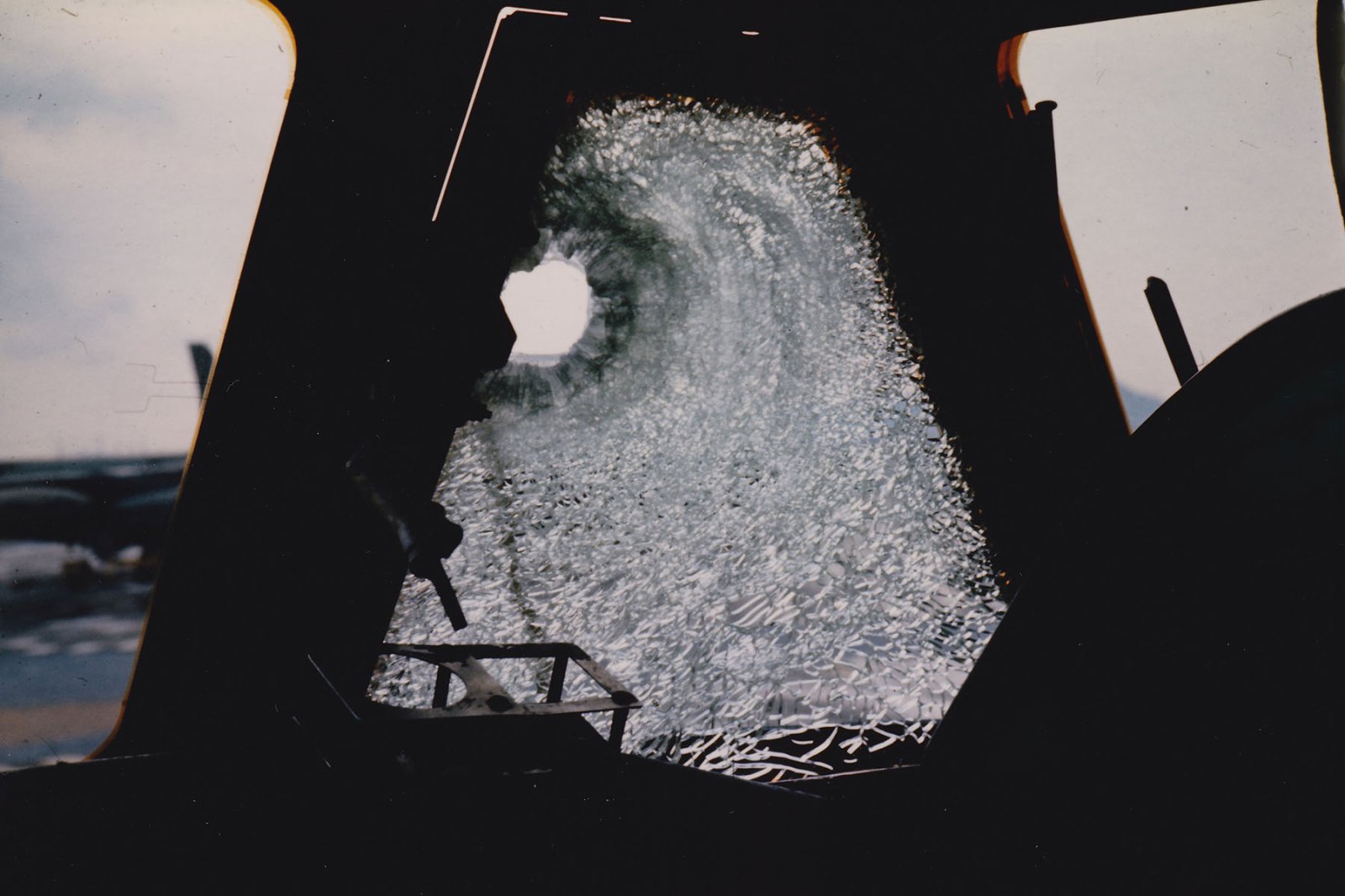
It was not invulnerable. B-52s were lost to accidents, mechanical failures, collisions, and enemy fire during the Southeast Asia war. The very first Arc Light mission had already killed crewmen before the formation reached Vietnam. Later crews faced antiaircraft fire and, particularly during operations over North Vietnam, surface-to-air missiles capable of tearing apart an aircraft weighing hundreds of thousands of pounds. That is where the enormous machine becomes a human story again. Inside every B-52 were men. There was an aircraft commander and pilot flying the bomber, navigators guiding it toward a release point, an electronic warfare officer trying to recognize and counter threats, and, in the Vietnam-era B-52D, a gunner positioned far to the rear of the aircraft. Their war might be fought at 30,000 feet, but engine failures, fire, structural damage, collisions, flak, and missiles did not care how large the airplane was. If the bomber could no longer be saved, survival could come down to an ejection seat. Ghosts of the Battlefield preserves a B-52D ejection seat, a surviving piece of the same model Stratofortress that became synonymous with the Big Belly missions over Southeast Asia. We do not claim that this particular seat flew an Arc Light mission without documentation establishing that history. It does not need that claim to matter. The artifact brings an enormous aircraft back to the scale of one person.
A B-52 photographed on a runway looks almost impossibly large. Its wings stretch 185 feet. Eight jet engines hang beneath them. Tens of thousands of pounds of bombs could be loaded aboard. But inside the aircraft, each crewman occupied a small working space surrounded by instruments, switches, communications equipment, oxygen systems, and the machinery necessary to keep him alive. An ejection seat existed for the moment when all of that machinery had failed. Seen by itself in a museum, the seat is easy to view simply as another complicated piece of aviation equipment. Put it back into the story of Arc Light and its meaning changes. B-52 crews launched across the Pacific on missions that could last for hours before they ever reached the target. They refueled in darkness, flew in formation, crossed hostile territory, released immense bomb loads, and then had to bring an aircraft weighing hundreds of thousands of pounds home again.
 Some did not. That is the connection between the artifact and Operation Arc Light. Not that the seat dropped bombs, and not that we need to invent a combat history for it, but that somebody sat in seats like it while these missions were being flown.
By August 15, 1973, American combat bombing operations in Southeast Asia had ended. During more than eight years of Arc Light operations, B-52 crews flew more than 126,000 combat sorties and dropped millions of tons of ordnance across Southeast Asia.
Numbers that large are almost useless unless they are brought back down to earth. One three-aircraft cell approaching unseen. A crew watching instruments rather than the target. A Marine in a fighting hole at Khe Sanh feeling the ground begin to shake. A North Vietnamese soldier who had never heard the aircraft suddenly surrounded by explosions. A maintenance crew on Guam preparing another bomber to fly. And an ejection seat waiting inside a B-52 in case the airplane did not make it home.
Operation Arc Light proved that the B-52 could become something its designers had never intended. It remained one of America's principal nuclear deterrents even while it was being used as an enormous conventional bomber over Vietnam. It attacked supply networks and remote jungle bases, but it could also be brought into battles such as Khe Sanh, An Loc, and Kontum where its bombs directly affected the survival of men fighting on the ground.
The Stratofortress became one of the most recognizable aircraft of the Vietnam War despite the strange fact that many of the enemy soldiers who experienced an Arc Light strike never saw the airplane responsible.
Sometimes they never even heard it coming.
Explore our collection of Stratofortress shirts