From WWI, The Silent Stakes of No Man’s Land
World War I Screw Pickets and the Making of the Battlefield
April 8, 2026

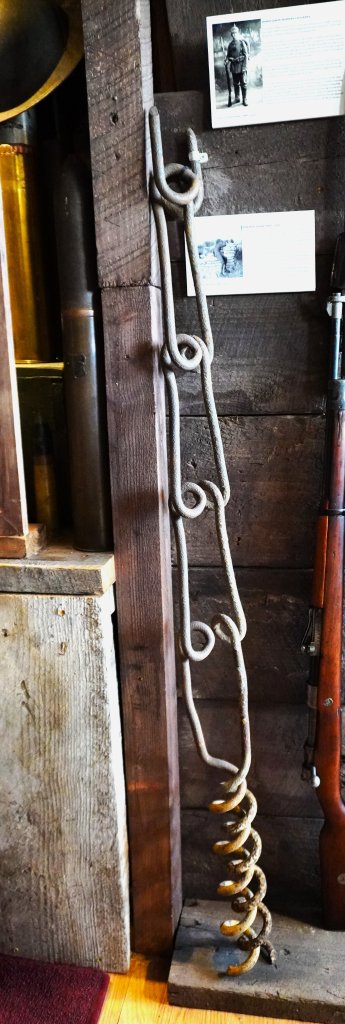
Not all weapons were meant to be carried into battle.
Some were driven into the ground—and left there to shape it.
The object displayed here is a World War I screw picket, a simple piece of steel that became one of the most important—and most dangerous—tools of trench warfare. Introduced in 1915, it replaced earlier wooden posts that had to be hammered into the earth, a process that created noise and often drew enemy fire.
This new design solved that problem.
Formed from a steel bar with its lower end bent into a spiral, the picket could be twisted silently into the ground. Along its length were three metal loops, or “eyes,” used to secure strands of barbed wire. Once emplaced, these pickets formed the backbone of defensive wire entanglements—dense, tangled barriers designed to slow, trap, and expose advancing soldiers.
They were known by many names.
British troops called them “corkscrew pickets”, referring to the way they were screwed into the earth rather than driven in. French soldiers referred to them as queue de cochon—“pig’s tail”—a name inspired by the spiral coil at the base.
Despite their simplicity, they were produced on an industrial scale. American manufacturer Crown Iron Works of Minneapolis alone produced more than ten million of these pickets during the war, a reflection of how essential they had become to the static, fortified front lines of Europe.
But their placement was anything but simple.
To install them, soldiers formed wiring parties—small groups that moved out under cover of darkness into no man’s land, the exposed and contested ground between opposing trench lines. Carrying pickets and coils of wire, they worked in silence, knowing that discovery meant immediate danger.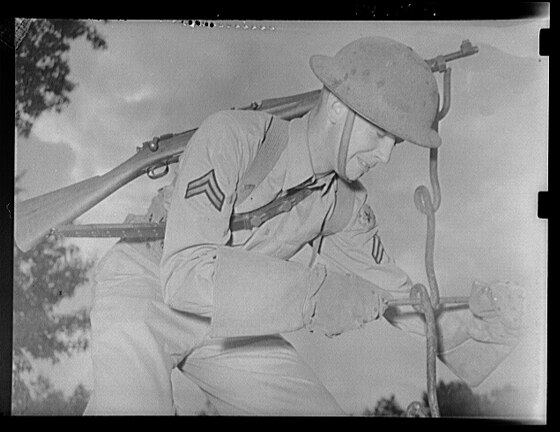
There, in the dark, they twisted these stakes into the earth and strung wire between them, building the obstacles that defined the battlefield.
By daylight, those same obstacles became deadly.
Barbed wire, anchored by these pickets, turned open ground into a trap. Advancing soldiers became entangled, slowed, and exposed to rifle and machine gun fire. Entire assaults could be halted not by a single weapon, but by the network created by objects like this one.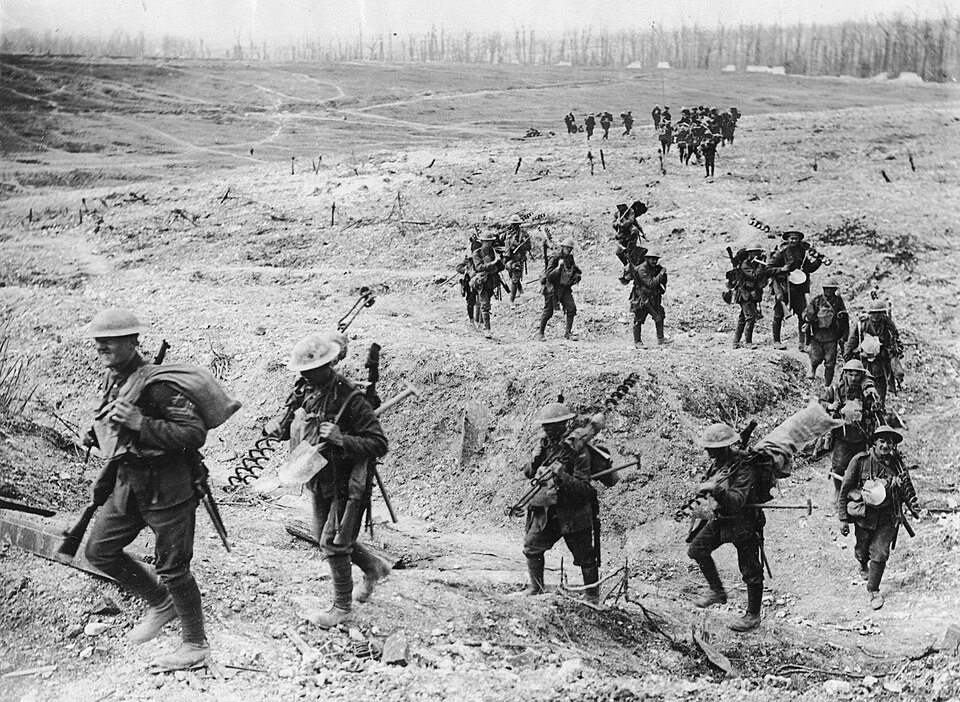
The screw picket is not dramatic. It does not carry the presence of a rifle or the weight of a uniform.
But it helped define the war.
Preserved within the collection of Ghosts of the Battlefield, it stands as a reminder that World War I was shaped not only by the weapons that fired—but by the ground itself, engineered to stop movement, control space, and turn the landscape into a weapon.