Badge No. 132: An Ordinary Worker in the Shadow of the Atomic Age
This Baker Brothers worker badge reflects American industrial labor and its quiet connection to the early nuclear program. Paired with Trinitite, it shows how the Cold War reached ordinary workplaces.
December 26, 2025

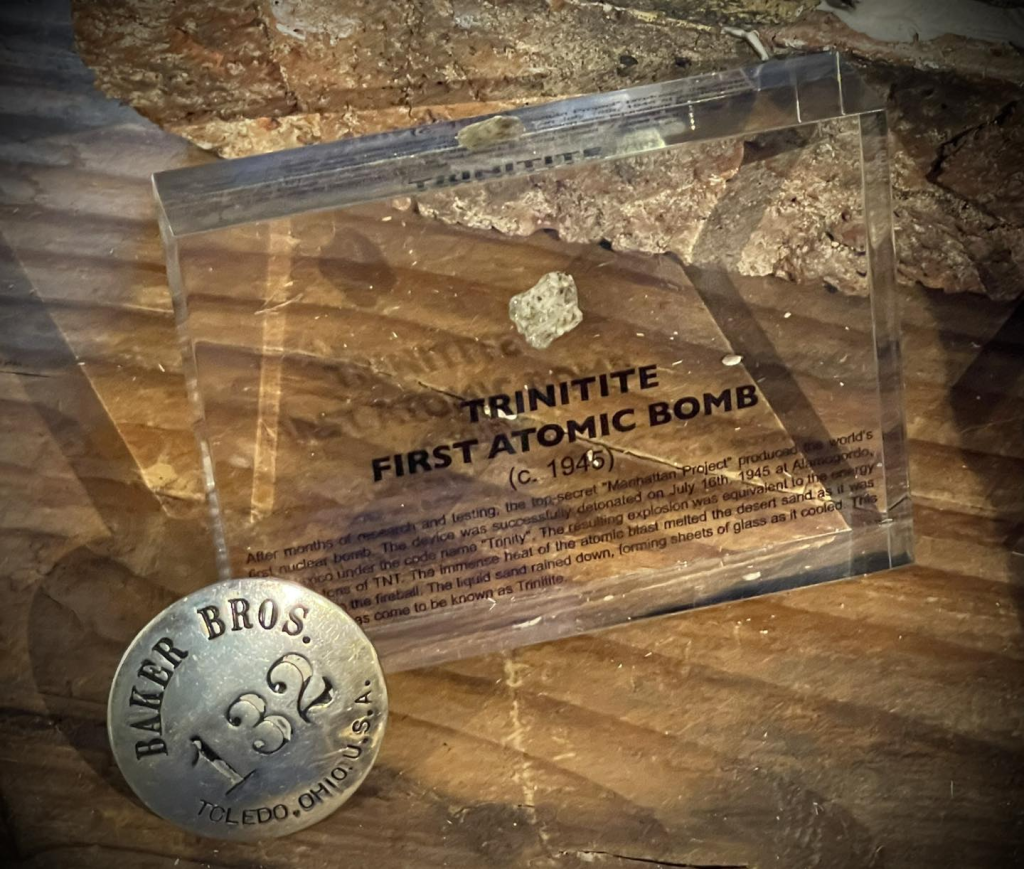 Baker Brothers Worker Badge, Toledo, Ohio
 Baker Brothers Worker Badge, Toledo, Ohio
Industrial Labor and the Quiet Reach of the Nuclear Age
This small worker’s badge carries the weight of a much larger story.
At first glance, it appears ordinary — a round piece of stamped metal, marked simply with a company name, a city, and a number. Objects like this once filled pockets, lunch pails, and locker rooms across industrial America. They were handled daily, worn without ceremony, and rarely preserved once their usefulness ended. Yet this badge, issued by Baker Brothers of Toledo, Ohio, survives as a tangible link to some of the most consequential forces that shaped the modern United States.
A Company That Helped Build Industrial America
Baker Brothers was founded in the 19th century during a period of explosive industrial growth in the United States. As railroads expanded, cities grew, and factories multiplied, the nation’s demand for precision machinery increased dramatically. Baker Brothers rose to prominence as a major manufacturer of woodworking and metalworking machine tools — the heavy, durable equipment that allowed raw materials to be shaped into standardized parts at scale.
These machines did not produce consumer goods themselves. Instead, they formed the foundation of production. Baker Brothers equipment powered factories that built furniture, ships, vehicles, industrial components, and infrastructure. In workshops and plants across the country, Baker Brothers machines cut, shaped, bored, and planed the materials that fueled America’s transformation into a global industrial power.
By the early 20th century, Baker Brothers had become a recognized name in American manufacturing. Their success reflected not only engineering expertise, but the presence of a skilled workforce capable of operating, maintaining, and improving complex industrial systems. That workforce was centered in Toledo.
The South Erie Street Plant
The Baker Brothers facility on South Erie Street was more than a production site. It was a cornerstone employer in Toledo — a city defined by manufacturing, transportation, and skilled labor. For generations, thousands of workers passed through its gates. Some arrived as young apprentices. Others spent their entire working lives inside its walls.
This plant functioned as a place of employment, training, and community continuity. Industrial skills were not abstract knowledge; they were learned through repetition, observation, and mentorship. Experienced machinists passed techniques down to younger workers. Precision, safety, and efficiency were not optional — they were essential. Mistakes could damage equipment, waste materials, or cause injury.
Badges like this one were part of that daily routine. Worn by machinists, toolmakers, inspectors, maintenance crews, and laborers, they served practical purposes: identification, access control, accountability. They marked a worker as authorized to be there, trusted to do their job among powerful machines that demanded attention and experience.
The badge did not confer prestige, rank, or recognition. It represented participation — showing up, day after day, to keep the machinery running and production moving. For many families, it represented stability. Wages earned at places like Baker Brothers paid rent or mortgages, bought groceries, and supported children through school. The badge was not symbolic at the time. It was simply part of going to work.
Industrial Labor and National Power
Factories like Baker Brothers were inseparable from national strength. Even before the Cold War, American industrial capacity was understood as a strategic asset. During times of war, machine tool manufacturers became essential to mobilization. The ability to rapidly produce weapons, vehicles, and infrastructure depended on skilled industrial labor and the machines that supported it.
This meant that industrial workers occupied a critical but often overlooked position in American history. They were not on battlefields, but their labor enabled those battlefields to exist. They were not celebrated in headlines, but their output sustained armies, navies, and air forces.
That relationship between civilian industry and national defense deepened dramatically during the mid-20th century.
A Hidden Role in the Nuclear Era
Less visible — and far more secret — was Baker Brothers’ later role during the Cold War.
During the early nuclear era, portions of the Baker Brothers facility were used in government-contracted work involving uranium slugs. These were machined components associated with the nation’s emerging nuclear program. The work was conducted under classification, and information was tightly controlled. As was common during the Manhattan Project and its immediate aftermath, civilian facilities were incorporated into the nuclear supply chain without public acknowledgment.
For the workers involved, the day-to-day experience may not have appeared unusual. Uranium machining was treated as industrial work, carried out under instructions that emphasized precision and security. Many employees were never informed of the broader purpose of what they were producing, nor of the long-term implications.
This was not unique to Toledo. Across the country, ordinary factories and workshops were quietly drawn into nuclear development. The Cold War blurred the boundaries between civilian labor and military power. Entire communities became participants in a global strategic contest without fully realizing it.
The Long Shadow of Secrecy
Decades later, the consequences of that classified work became visible.
Radioactive contamination linked to the uranium machining activities led the Baker Brothers site to be designated as a Department of Energy cleanup location. Environmental remediation efforts were undertaken to address residual contamination — a process that underscored how deeply Cold War activities had penetrated everyday American spaces.
What had once been a routine workplace was revealed to carry a nuclear legacy. The cleanup did not erase the history; it documented it. Official records and remediation programs became part of the site’s story, transforming Baker Brothers from a symbol of industrial achievement into a case study in the long-term costs of secrecy.
For the surrounding community, this revelation was sobering. It demonstrated that the nuclear age was not confined to remote test sites, research laboratories, or missile fields. It unfolded in cities, neighborhoods, and workplaces — often without the knowledge of the people most directly involved.
A Badge as Historical Evidence
This worker’s badge stands at the intersection of those histories.
It links the rise of American manufacturing to the lived experience of industrial workers. It connects Toledo’s identity as a factory city to a national defense effort that extended far beyond conventional warfare. And it anchors abstract Cold War narratives in a physical object that once belonged to a real person whose name is now unknown.
The badge does not tell us who wore it. It does not tell us their specific job, their views, or whether they were aware of the nuclear work conducted at the plant. To invent those details would be to distort the artifact’s meaning. Instead, the badge invites reflection on what is not recorded — the countless individual lives that made history possible without being documented in it.
Paired With Trinitite
Displayed alongside this badge is a fragment of Trinitite — glass formed when the world’s first atomic bomb detonated in the New Mexico desert on July 16, 1945. The intense heat of the explosion fused sand and debris into a glassy material that became one of the most recognizable physical remnants of the nuclear age’s beginning.
The pairing is deliberate.
Trinitite represents the moment — the instant when nuclear power was unleashed and the world irrevocably changed. The Baker Brothers badge represents the system — the industrial labor, infrastructure, and manufacturing capacity that made such moments possible.
One object was created in a fraction of a second. The other was worn over years of work.
Together, they collapse distance between cause and effect, between factory floor and test site, between ordinary labor and extraordinary consequence.
History Without Uniforms
This badge reminds us that history is not always marked by uniforms, medals, or ceremonies. Many of the most consequential developments in American history were carried quietly, by people whose contributions were routine rather than heroic, essential rather than celebrated.
The industrial worker whose badge this was likely did not see themselves as part of the nuclear age. They were doing a job, supporting a family, and contributing to a company that had existed long before nuclear weapons and would outlast the secrecy surrounding them. Yet their labor — and the labor of thousands like them — formed the unseen foundation of modern power.
Why This Artifact Matters
Preserving objects like this badge expands how history is told.
It allows museums to move beyond battlefield narratives and into the systems that sustain them. It honors the reality that American history is shaped not only by moments of violence or decision, but by sustained effort — by factories, workers, and communities whose stories rarely survive intact.
At Ghosts of the Battlefield, this badge stands as a reminder that the past is often quieter than we expect. Sometimes, it survives not in monuments, but in small pieces of metal that once marked nothing more remarkable than the start of another workday.
And yet, those workdays helped shape the world we inherited.
Artifact preserved by Ghosts of the Battlefield.